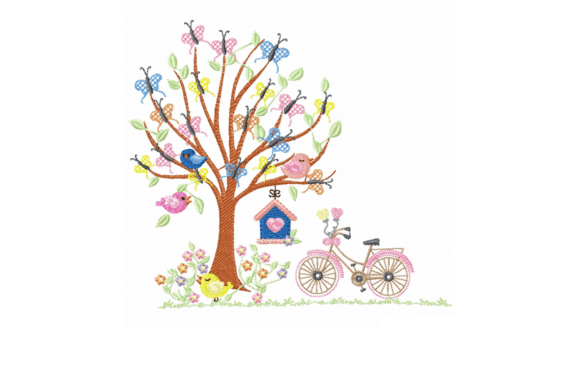
Spring Tree Birds Bicycle Embroidery
A Whimsical Yet Professional Brand Asset for Small Business Merch
As an embroidery designer who’s digitized and stitched over 2,000 commercial projects—from café aprons to boutique tote bags—I approached Spring Tree Birds Bicycle Embroidery with both curiosity and scrutiny. The title alone evokes warmth and narrative: a tree, birds, butterflies, flowers, a birdhouse, and a vintage bicycle—all nestled in a cohesive, hand-drawn rhythm. First impression? It reads as friendly, handmade, and gently nostalgic—not overly rustic, not aggressively modern, but unmistakably intentional. That balance is rare—and valuable—for small businesses building authentic brand identity.
Where This Design Earns Its Keep in Real Business Use
Spring Tree Birds Bicycle Embroidery isn’t just “cute”—it’s functionally versatile across high-visibility branded touchpoints. On staff aprons for a florist or neighborhood bakery? It softens professionalism with approachability—no sterile logo needed when your team wears charm that sparks conversation. As a 2.5” embroidered patch on tote bags for a handmade studio or indie bookstore? It becomes a subtle signature—recognizable at a glance, memorable without shouting. For cap embroidery (front or side), the vertical tree composition anchors well above the bill, especially when scaled to 3–3.5”. And on uniform sleeves or chest accents for a creative studio or pet wellness brand? Its layered elements—birds in flight, pedals mid-turn, blossoms trailing branches—add quiet storytelling that reinforces values: care, growth, joy, connection to nature.
It also performs beautifully as a product packaging accent: think stitched onto linen gift tags for a baby boutique, or centered on organic cotton drawstring bags for a local herbalist. Because it’s rooted in the Forest category yet avoids cliché (no moose, no pinecones), it feels fresh—not generic. Even as a digital embroidery file for printable mockups, its balanced negative space and clear silhouette ensure crisp rendering across web, social, and pitch decks.
Use With Intention: Where Detail Meets Practicality
That said, Spring Tree Birds Bicycle Embroidery rewards thoughtful placement—and signals caution in certain contexts. Its charm lives in detail: delicate butterfly wings, fine branch lines, and the intricate lattice of the birdhouse. That means avoid scaling below 2” for embroidered patches or cap fronts—stitch density will blur nuance, and thread tension may cause puckering on textured fabric like canvas or twill. On dark uniforms (navy chef coats, charcoal work shirts), confirm thread color contrast: light pastels may fade visually unless paired with tone-on-tone depth or outlined stitching. Also, test on curved surfaces—like baseball caps—where distortion can stretch the bicycle frame or compress flower spacing.
For high-wear items—towels, aprons, reusable totes—review stitch density and underlay strategy. A design this rich benefits from proper stabilizer (cutaway for knits, tear-away for stable wovens) and a medium-density fill to prevent stiffness. And while it shines on natural fibers (linen, cotton duck, chambray), proceed carefully on fleece or terry cloth: dense fills may sink or distort unless digitized with adjusted tension and reduced density.
How It Strengthens Brand Identity—Beyond Aesthetic
Small business merch isn’t just about visibility—it’s about resonance. Spring Tree Birds Bicycle Embroidery supports that by projecting thoughtful craftsmanship without pretension. Customers don’t just see a logo; they sense intentionality—a business that chooses beauty with purpose. That builds trust faster than a stock icon ever could. When used consistently across aprons, tote bags, and thank-you cards, it creates visual consistency that elevates perceived value—especially for handmade product brands on Etsy or local markets. Buyers engage more deeply with merchandise that tells a story, and this design does exactly that: growth (the tree), community (birds nesting), play (the bicycle), and renewal (butterflies, blossoms).
Importantly, it avoids seasonal limitation despite “Spring” in the name—the vintage bicycle and birdhouse lend timeless appeal, making it viable year-round for cafés, studios, and boutiques seeking enduring design assets—not trend-chasing flash.
Practical Designer Notes Before You Stitch
- Always test in black and white first—to assess contrast, silhouette clarity, and balance before committing to thread colors.
- Check small-patch viability: render at 1.75” and 2” to confirm legibility of the birdhouse roof, bicycle spokes, and flower centers.
- Review thread color contrast on your target fabric—especially for commercial embroidery where lighting and laundering affect longevity.
- Inspect spacing between elements: tight gaps (e.g., between bike wheel and branch) may close up on low-stitch-count machines or dense fabrics.
- Confirm hoop size compatibility—this design likely fits standard 4×4 or 5×7 hoops, but verify before batching orders.
- Test on real fabric, not just stabilizer—texture impacts how threads lay and how details read post-stitch.
- Create a client-facing mockup using the digital embroidery file—show it on an apron, cap, and tote bag to align expectations early.
- Compare beside existing design assets: does it harmonize with your current logo, typography, or brand palette—or create unintended visual competition?
- Confirm commercial licensing before production—this is essential for small business merch, custom apparel, and resale items. If unclear, contact the seller directly.
In short, Spring Tree Birds Bicycle Embroidery is more than a machine embroidery design—it’s a quietly strategic brand amplifier. When applied with attention to scale, fabric, and context, it transforms everyday items into meaningful brand moments. For embroidery shops, crafters, and small business owners building something real? That’s not decoration. That’s distinction.